
|
Island of Doctor Moreau, The Time Machine, War of the Worlds, The Invisible Man
science fiction links
|
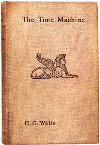
The Time Machine by H.G. Wells was published 1895 and describes a time travel far into the future.
The Time Traveller returns and describes how evolution has made the human being split into two races;
the beautiful but incompetent Eloi and the disgusting Morlocks, and how conflicts has arisen between the two.
|
The first science fiction novel
Many has tried to define SF and Fantasy, but noone has yet succed. If you wish to find many defintions, try reading "Critical Terms for SF and Fantasy" by Gary K. Wolfe.
The first "real" SF-novel is by many considered to be
Mary Shelley's "Frankenstein" (1818).
The story is built on the science of that age, and many events is given explanations in a scientific way.
The authors that started SF in the way we know it today was Jules Verne, among his most famous books are
"From the Earth to the Moon" (De La Terre a la Lune, 1873) and "Journey to the Centre of the Earth" (Le Voyage au centre de la Terre, 1864), and H.G. Wells, "The War of the Worlds", 1898 and "The Time Machine: an invention", 1895.
Other authors that are seen as pioneers are Robert Louis Stevenson "The Strange Case of Dr. Jekyll and Mr. Hyde", 1886 and Edgar Allan Poe.
Edgar Allan Poe is mostly famous for his many tales or horror, but many of his stories are very close to SF.
- Science Fiction as its own genre
Books at Amazon.co.uk (Europe):
Critical Terms for SF and Fantasy (1986)
Frankenstein
Journey to the Centre of the Earth Jules Verne
From the Earth to the Moon Jules Verne
The Time Machine H.G. Wells
The War of the Worlds H.G. Wells
Dr Jekyll and Mr Hyde
Books at Amazon.com (USA):
Frankenstein
Journey to the Centre of the Earth Jules Verne
From the Earth to the Moon Jules Verne
The Time Machine H.G. Wells
The War of the Worlds H.G. Wells
Dr Jekyll and Mr Hyde